React + TypeScript
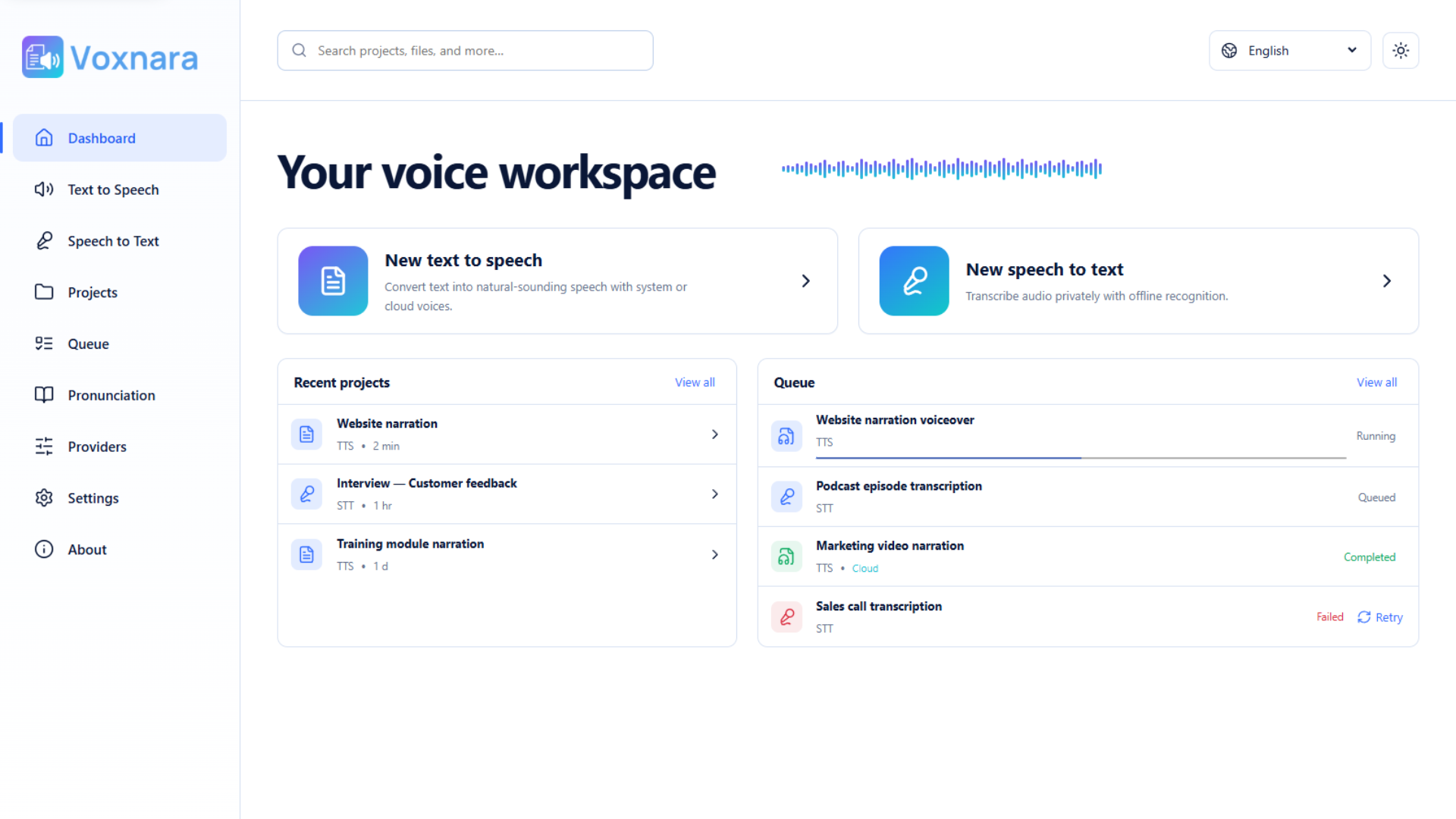
Dashboard, TTS and STT editors, projects, pronunciation, providers, queues, settings, and localization.
Production software
Live product01 / Latest product
A local-first voice workspace for producing speech from text, transcribing supported audio locally, refining pronunciation, and managing voice projects from one desktop application.
/overview/product.md
Voxnara brings text-to-speech authoring, speech-to-text workflows, pronunciation management, voice providers, project organization, processing queues, and exports into a focused desktop product. Its local-first architecture keeps projects and application state on the user's device.
My role spans product planning, software architecture, React and TypeScript interface development, Tauri and Rust native services, SQLite persistence, native speech integration, voice-provider boundaries, licensing, testing, packaging, and release maintenance.
/architecture/system.map
The product separates interactive editing, native operations, persisted project state, and speech engines. Platform-specific capabilities are exposed through a narrow typed bridge rather than leaking operating-system details into the interface.
Dashboard, TTS and STT editors, projects, pronunciation, providers, queues, settings, and localization.
Typed commands and events connect the interface to speech, storage, licensing, filesystem, and export operations.
Validation, platform adapters, offline-recognizer checks, queue work, secure configuration, and native integration.
Local project state and pronunciation data connect deliberately to installed voices, offline recognition, or configured providers.
/engineering/decisions.log
The engineering focus is durable user work: text edits, pronunciation rules, processing state, capability checks, and exports must remain understandable and recoverable across sessions.
Projects, editor state, pronunciation data, and operational records persist locally so the desktop application remains the source of truth.
Offline transcription checks available native recognizers and supported locales before presenting the capability as usable.
Text effects are rebased across insertions, deletions, replacements, and Unicode content instead of being discarded after every edit.
Shared persisted pronunciation rules remain available across navigation and are applied through a consistent project-level workflow.
Running, queued, completed, and failed speech tasks stay visible so users can understand progress and recover from errors.
License verification, production-key checks, tests, artifact metadata, signing gates, and Windows/macOS packaging form part of the delivery pipeline.
/next/connect.sh
I design cross-platform applications where interface state, native capabilities, local data, provider boundaries, packaging, and long-term maintenance work as one product.